Followkite resources
How to start a follow up email, with sales examples
Start a follow up email by reminding the reader of the earlier topic in one sentence, then add something new: a useful detail, a simpler question or a different next step. Avoid openers that only say you are following up. The examples below cover the most common sales situations, including a follow up to no response.
By Followkite. Last updated . Product built by Shahab Dev.
14 days, no card needed. Paid plans from $15 per workspace per month.
How do you start a follow up email?
The first line of a follow-up has one job: let a busy reader understand, without scrolling, what this is about and why it is worth answering now. Name the earlier topic, then move straight to what is new.
| Situation | Opening line |
|---|---|
| No reply to a cold email | One more detail on the onboarding question I sent on Tuesday. |
| After a call or meeting | Thanks for the call today. Here are the two options we discussed. |
| After sending a proposal | Is there anything in the proposal your team needs clarified before Friday's review? |
| They asked you to check back | You mentioned the budget would be set in March, so I am checking back as agreed. |
| Wrong person | If someone else looks after supplier reviews, could you point me to them? |
Each opener refers to something real and makes the next step obvious. "Just following up" and "bumping this to the top of your inbox" do neither: they describe your action instead of the reader's benefit.
How do you send a follow-up email step by step?
- Check that a follow-up is still needed. Look for a reply in every inbox you use, including an out-of-office with a return date or a note from a colleague.
- Reply in the existing thread. The reader sees your first message beneath the new one, so you do not need to repeat it.
- Write one new sentence of value. A short example, a relevant number from your own work, a lighter version of the request or an answer to a likely objection.
- Ask a smaller question. If a 30-minute call was too much, ask whether a two-line answer by email works.
- Keep it shorter than the first email. Three to five sentences is usually enough.
- Set the next gap. Leave more time before each later step, and stop after two or three follow-ups.
What is a good follow up email for sales?
A good sales follow-up is specific, short and easy to answer. These templates use Followkite placeholders; text after the vertical bar is the fallback when a field is empty. They are examples of structure, not results from real campaigns.
Template 1: first follow-up after a cold email
Hi {{first_name|there}},

One detail I left out: teams like {{company|yours}} usually start with a
single onboarding checklist before changing tools, so the first step
is small.

Would it help if I sent the checklist we use? A yes or no is fine.

[Name]
Template 2: after a meeting
Hi {{first_name|there}},

Thanks for your time today. As agreed:
1. I will send the revised quote by Thursday.
2. You will confirm who joins the pilot review.

If I missed anything from the call, reply here and I will add it.

[Name]
Template 3: after a proposal
Hi {{first_name|there}},

Before your review on Friday, is there any part of the proposal that
needs a clearer price, timeline or scope? I can answer by email or
in a 10-minute call, whichever is easier.

[Name]
How do you follow up when there is no response?
A follow up to no response should make replying easier, not apply pressure. Change the angle rather than repeating the pitch: offer a smaller step, ask whether you have the right person, or give the reader an explicit way to say no.
Template 4: second follow-up with a different angle
Hi {{first_name|there}},

Maybe onboarding is not the issue for {{company|your team}} right now.
Is reporting a bigger time cost? If so, I can share how other
agencies structure it. If neither applies, no reply is needed.

[Name]
Template 5: final, polite close
Hi {{first_name|there}},

I will not keep emailing about this. If it becomes a priority later,
this thread will reach me directly.

Thanks for reading,
[Name]
A clear last email is respectful and often gets an answer such as "not now, try again in Q3". Once someone says no or asks you to stop, add them to your do-not-contact list rather than starting another sequence.
Which follow-up habits should you avoid?
- Guilt or false urgency. "I guess you are not interested" or a deadline that does not exist.
- Fake replies. Adding Re: or Fwd: to a message that was never sent before misleads the reader and can breach the FTC's rule against deceptive subject lines.
- Sending after a reply. A scheduled follow-up that arrives after someone has already answered looks careless.
- Too many steps. Each extra email to people who did not ask for it increases the chance of spam complaints.
- Repeating the whole first email. The thread already contains it.
How does Followkite send sales follow-ups?
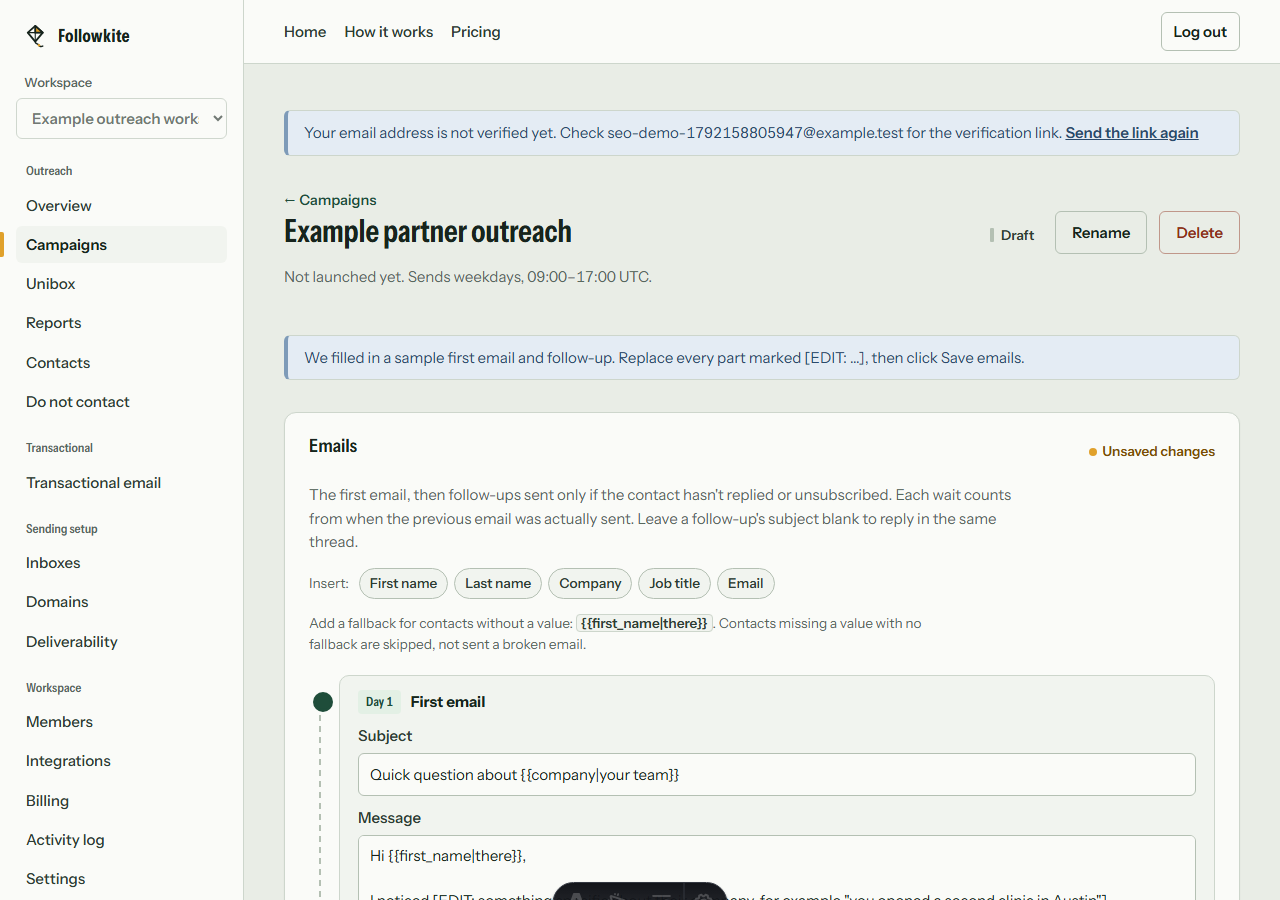
In a Followkite sequence, each step has a delay in days after the previous email. Leave a follow-up's subject empty and it is sent as a reply to your first email, with the subject "Re:" plus the original subject and the threading headers mail apps use, from the same inbox that started the conversation. Steps can have B and C variants to compare wording.
Before each step is sent, Followkite checks the contact again. A matched human reply, an unsubscribe or a bounce stops the remaining steps after your inbox syncs, and replies appear in the unified inbox. Out-of-office replies are recognised as automatic, not counted as human replies. Read more about stopping follow-ups when someone replies.
What does Followkite cost?
Plans are billed per workspace. Mailbox hosting and domain registration are separate purchases. Choose a plan by total campaign sends, including follow-ups, rather than the size of your prospect list alone.
| Plan | Monthly price | Inboxes | Campaign emails / month |
|---|---|---|---|
| Starter | $15 | 5 | 3,000 |
| Growth | $40 | 25 | 15,000 |
| Scale | $100 | 100 | 60,000 |
The trial lasts 14 days with Starter limits and every feature. Followkite has no permanent free plan, inbox warm-up network, or guarantee of inbox placement. Review the full pricing and billing terms.
Frequently asked questions
How long should I wait before sending a follow-up email?
For a first cold email, two to four business days is a common gap, and longer gaps for later steps. After a meeting or a promised answer, follow up on the date you agreed. There is no single correct number; pick a pace the reader would find reasonable.
How many follow-ups should a sales sequence have?
Two or three follow-ups after the first email is enough for most cold outreach. Each one needs a new reason to exist. Followkite allows up to 10 emails per sequence, but that is a ceiling, not a target.
Should a follow-up reply in the same thread?
Usually yes, because the reader sees the earlier message for context. Only use a reply when it is a genuine reply to your own earlier email. Adding Re: to a first message is misleading.
Build a small campaign you can review
Connect a mailbox you control, check the audience and suppression list, and test with your own address before launching.
Create your workspace